Every day, millions of people search Google for the exact products and services small businesses offer. Google’s own figures put annual search volume at more than 5 trillion queries a year, which works out to roughly 13–14 billion searches a day. Every one of those searches is a moment of intent: someone actively looking for a solution. If your business isn’t visible in those results, a competitor is capturing that opportunity instead.
That’s what makes SEO for small business different from most marketing spend. It’s not about interrupting people with an ad; it’s about showing up exactly when someone is already looking for what you do. This guide breaks down what SEO actually does for a small business, the benefits worth prioritizing, and how to know it’s working.
What Is SEO, and Why Seo for Small Business Matter ?
Search Engine Optimization (SEO) is the practice of improving a website’s technical structure, content, and user experience so it ranks higher in search results — particularly on Google, which still handles the overwhelming majority of global search traffic.
Unlike paid ads, which stop generating traffic the moment you stop paying, SEO builds a compounding asset. A well-optimized page can continue attracting visitors and leads for years after it’s published.
For small businesses specifically, SEO matters because it:
- Levels the playing field against larger, better-funded competitors
- Delivers consistent visibility without an ongoing ad budget
- Builds trust through organic, earned rankings rather than paid placements
- Generates leads at a lower cost than most traditional marketing channels
Key Benefits of SEO for Small Business
1. Increased Online Visibility
Most users never scroll past the first page of Google. Ranking there — for the keywords your customers actually search — puts your business directly in front of people who are already looking for what you sell. Over time, consistent visibility also does something subtler: it associates your brand with the solution, so people start recognizing your name before they even click.
2. Stronger Credibility and Trust
Google’s ranking systems are built around demonstrating expertise, authority, and trustworthiness — often summarized as E-E-A-T. A high ranking functions as a quiet trust signal: if Google considers a page worth showing first, visitors tend to extend that same confidence to the business behind it. That’s a kind of credibility paid ads can’t buy, because users know organic rankings are earned, not purchased.
3. Precise Audience Targeting
SEO lets you target the exact phrases your ideal customers type into Google. Someone searching “affordable digital marketing services for small businesses” has already done the work of defining their need — they’re not a cold prospect, they’re a warm lead with active intent. That precision means your traffic is higher-quality from the moment it arrives.
4. A Real Competitive Advantage
In crowded markets, outranking a competitor for a valuable keyword isn’t just a visibility win, it’s a market-share win. Even moving up a single position on a competitive search term can translate into a meaningful jump in monthly leads.
5. Insight Into Your Market
Tools like Google Analytics 4 and Google Search Console turn SEO into a research function as much as a marketing one. Done consistently, it reveals which keywords actually drive qualified traffic, what content resonates with your audience, where demand is concentrated geographically, and where the gaps are between what people search for and what currently ranks. That data informs decisions well beyond SEO.
6. Better Content, by Necessity
Effective SEO forces you to research what your audience actually wants to know before you write anything. The result tends to be more useful content than guesswork produces, content that answers real questions instead of restating what you assume people want to hear. Over time, that consistency builds authority and a returning audience.
7. Higher Conversion Rates
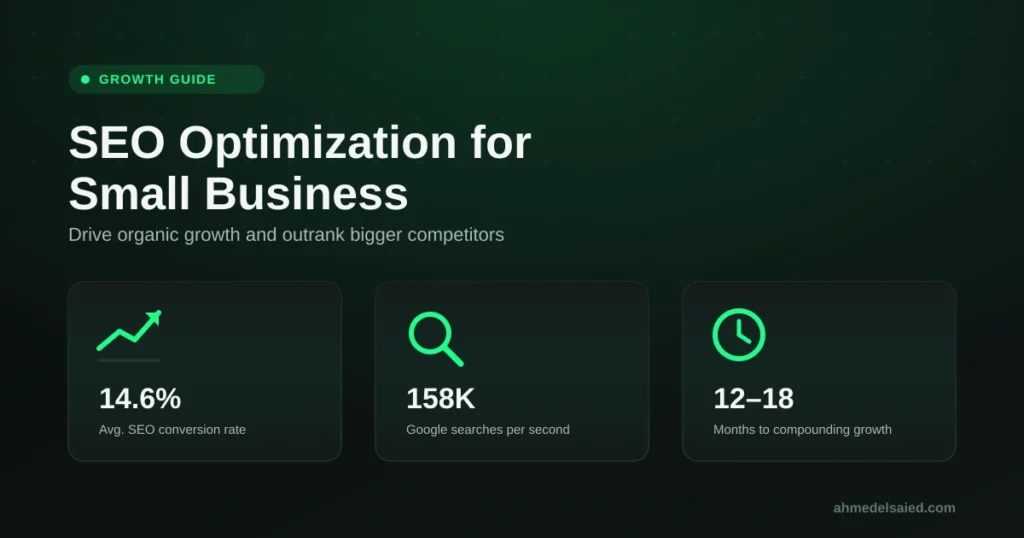
Traffic only matters if it converts, and organic search traffic tends to convert well because it arrives with intent already attached. Industry benchmarks from HubSpot put the average close rate for SEO-driven leads at around 14.6%, compared to roughly 1.7% for traditional outbound marketing. That gap is the difference between chasing leads and having qualified ones find you.
How SEO Drives Business Growth and Revenue
SEO supports the entire buying journey rather than a single touchpoint:
- Awareness stage — educational content helps potential customers discover that a solution (and your business) exists
- Consideration stage — comparison guides and detailed resources help them evaluate their options
- Decision stage — service pages, case studies, and testimonials convert visitors who are ready to buy
By showing up consistently across that journey, SEO does double duty: it builds the relationship and closes the sale.
As organic traffic grows, dependence on paid advertising typically shrinks, which directly improves customer acquisition cost. Paid channels require continuous spend to maintain visibility; a well-optimized page keeps generating traffic and leads long after the work that created it is finished.
SEO vs. Paid Advertising: The Cost Comparison
| Paid Search | SEO | |
|---|---|---|
| Visibility | Stops the moment the budget does | Continues after the initial investment |
| Cost pattern | Ongoing, scales with traffic | Front-loaded, then largely maintenance |
| Trust signal | Perceived as sponsored | Perceived as earned |
| Tracking | Strong, real-time | Strong, with a longer attribution window |
The global SEO services market has grown into an industry valued at well over $80 billion, with most market research firms projecting continued double-digit annual growth over the next several years. That growth reflects a simple shift: more businesses recognizing that organic visibility delivers a stronger long-term return than ad spend alone.
Measuring SEO Success
SEO is only useful if you can tell whether it’s working. The metrics that actually connect to business outcomes are:
- Organic traffic volume — total visitors arriving through search, and the trend over time
- Keyword rankings — tracked for the terms that drive qualified traffic and conversions, not just volume
- Conversion rate — the percentage of organic visitors completing a meaningful action
- Bounce rate — a high rate often signals mismatched intent or a weak landing experience
- Click-through rate (CTR) — how often your listing gets clicked when it appears in results
- Revenue attribution — the metric that ultimately matters most
Google Analytics 4 and Google Search Console provide this data for free. The work that matters is building dashboards around the metrics tied to your business goals, then using the data to spot high-opportunity keywords, seasonal patterns, and gaps competitors haven’t filled yet.
Getting Started With SEO for Your Business
SEO rewards consistency more than intensity. Most businesses start seeing meaningful movement within 3–6 months, with the larger compounding gains showing up between 12 and 18 months of sustained effort. The businesses that struggle with SEO usually aren’t doing it wrong technically, they’re stopping before the compounding effect kicks in.
If you’d rather not navigate that timeline alone, our SEO services are built specifically around small and mid-sized businesses competing against larger, better-funded competitors. We focus on the fundamentals that actually move rankings: technical SEO, content built around real search intent, and reporting tied to leads and revenue, not vanity metrics.
Conclusion
SEO is no longer optional groundwork for small businesses, it’s one of the few marketing channels where the investment compounds instead of resetting every month. Organic leads close at meaningfully higher rates than outbound marketing, and with global search volume continuing to climb, the businesses that build SEO foundations now will be the ones capturing that demand before competitors do.
Focus on the fundamentals, stay consistent past the first few months, and measure results against business outcomes rather than rankings alone.
FAQs About SEO for Small Business
What is SEO, and why does it matter for my small business?
SEO is the practice of optimizing your website to rank higher in search results for terms relevant to your business. It matters because most people research online before buying, and SEO ensures your business appears when they’re actively looking.
How long does it take to see results from SEO?
Most businesses see early movement within 3–6 months, with the more significant, compounding results typically emerging between 12 and 18 months. Timelines depend on keyword competitiveness, current site quality, and consistency of effort.
What’s the difference between organic and paid search results?
Organic results are earned through optimization and ranked by relevance. Paid results are sponsored listings billed per click. Paid search delivers immediate traffic; organic search builds visibility that compounds and tends to convert at a higher rate.
How much does SEO cost for a small business?
Costs vary by approach. DIY SEO might run $100–500/month in tools. Freelance specialists typically charge $500–2,000/month, while agencies range from roughly $1,000–5,000+/month depending on scope and market competitiveness.
Which keywords should I target first?
Target the terms your actual customers search, not the terms you assume they use. Prioritize keywords with realistic ranking potential and clear commercial intent over high-volume terms you have little chance of winning early on.
How do I know if my SEO is actually working?
Track organic traffic, keyword rankings, conversion rate, and revenue attributed to organic search using Google Analytics and Search Console. Anchor your reporting to business outcomes, not vanity metrics like impressions alone.
Ready to build a search strategy that actually moves revenue? Get in touch and we’ll walk you through where the opportunity is for your business.